
Who Decides Which Voices Are Too Dangerous?
Echo Chambers Don’t Make Literature
Words by Evangelia Karageorgos
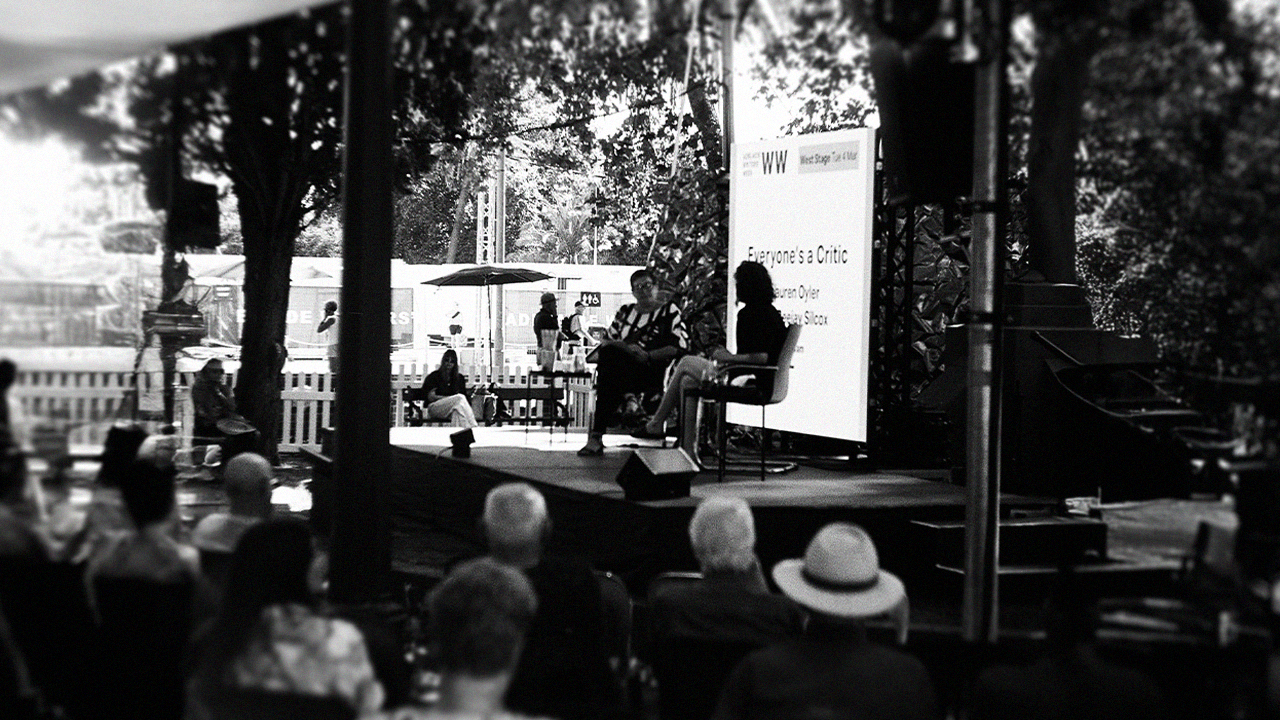
Adelaide Writers’ Week 2025. Photo by Kane Midgley.
I am not shy about admitting that I have not enjoyed the changes Louise Adler made to Adelaide Writers Week when she became director. I felt like it became less a writer's festival and more an opinion festival.
Last year, almost every panel I attended didn’t promote the author's book, and the host sometimes dominated the conversation. Sometimes I wondered if the host even read the book they were there for. Many talks quickly shifted from the book to current events. Most talks didn't even read an excerpt from the book. There were panels on topics that weren't even related to books or writing. There was a large number of paid events, which I understand is needed to keep funding Writers Week. But I can't help but be disheartened at the loss this is to what was a free event. And then there was the introduction of Podfest, which just plain confused me.
I missed the mixture of topics and fiction, I missed the escapism, I missed the new books and new writers that I had grown used to over the ten years I have been attending Writers Week.
But things change, we don't always like it, that’s life. And though I am not fond of the changes, I can accept them.
Recently (Thursday, 8th January), the former Adelaide Festival board announced the removal of writer Dr Randa Abdel-Fattah from the 2026 Adelaide Writers Festival. This has proven to be a highly controversial decision among the public, participating writers, and some festival staff. A decision, I believe, is not even a standard administrative decision for the board to make.
This act, which one can describe as a form of censorship, cuts directly against the purpose of a writer’s festival. A purpose Louise Adler and our Premier Peter Malinauskas defended in 2023. When there were calls to pull Writer Susan Abulhawa from the lineup because of her views about Russia's invasion of Ukraine. There were also calls to defend the festival if she stayed.
At the time, Adler and Malinauskas argued that writers’ festivals must resist calls to silence voices simply because they are contentious or politically charged. Affirming that literature, thoughts, opinions and debate are not neutral and should not be made so for the sake of comfort and institutional ease.
There was even a panel called The Public Square, a discussion about listening to voices with which we disagree.
“There is a profound responsibility on government, particularly in our democratic system, to ensure freedom of speech isn’t compromised by cancel culture, every time something bobs up that we might disagree with. The whole idea of Writers Week is to hear other perspectives, even if we don’t particularly like them.
This principle cannot be selectively applied. Yet it has been.
Defending the platforming of challenging voices in one year (2023) and then supporting their removal in another exposes a deep hypocrisy. A hypocrisy our Premier also seems to share.
This removal suggests that “free discussion” is only supported by the former Adelaide Festival board and our Premier when it aligns with their acceptable boundaries. Abandoned quickly when it doesn't fit the current dominant narrative, threatens reputational comfort or creates donor anxiety.
The former Adelaide Festival board's decision has taken away our autonomy as attendees, determining what is safe for us to hear and discuss. Their decision reveals a lack of faith in the public to think critically and independently. It shows a lack of faith in the public's ability to make their own minds up about any given situation.
They should not decide which opinions and ideas are ‘safe‘ enough to be heard. They should not decide what is acceptable for us to listen to.
Writers’ festivals exist to host discussions, to challenge us. They are a space where ideas are tested, where audiences are exposed to perspectives that challenge their assumptions, and where writers are trusted to speak and can be questioned in a public forum. Writers' festivals should not be worrying about micromanaging comfort zones.
“...Art holds a mirror up to Society and should be a space where controversial ideas can be examined without censorship and political interference. This decision will undermine the independence and credibility of Writers Week…” -Robert Simms MLC
The exclusion of views people disagree with or don't like should not become the norm. You can not create an offence-free zone, especially at a literary festival.
So I ask, is this decision a sign that we are losing the art of the respectful exchange of ideas and open discussion?
Sadly, this decision by the former Adelaide Festival board has proven terminal for our beloved Writers' Festival. Showing that they had clearly underestimated the feelings of many of the Writers, festival staff and the public on the exclusion of a writer.
Can you feel the ‘community cohesion’ now, former Adelaide Festival board and Premier?
I asked Flinders University Senior Lecturer and award-winning author Dr Sean Williams for his thoughts on this situation.
(Williams has sat on several writing-related boards in Adelaide, was once Chair of Writers SA, was a founding board member of Raising Literacy Australia, has been on the advisory board of the Fringe’s Word festival, and was a member of the advisory committee of Adelaide Writers’ Week, 2010-2017.)
Williams expressed that the lack of practising artists and writers in the consultation process was shameful. Stating “Irrespective of where one stands on the wider issue, the smothering of conversation politicians like Mali will not solve anything. It will, as we have seen here, make things worse.” Williams believes that an immediate apology and reinstatement to Adelaide Writers Week should be given to Dr Randa. Adding that “...assurance (needs to be) given that arts boards will be more representative of the audience and artists.”
I believe the Adelaide Festival board needs to include artists and writers. With the other board members having some involvement in the arts in some form. I believe this will help ensure that the perspectives of the artist and the arts community are more adequately represented, as Williams expressed.
Adelaide Writers’ Week is not just a line-up of authors; it is a public forum. Its value lies in the conversations it sparks among writers, readers, and the broader public. Removing a voice because it may provoke discomfort diminishes the festival; it replaces intellectual engagement with risk management and control.
When institutions claim to champion ideas but retreat the moment those ideas become uncomfortable, they undermine their own credibility. I believe that excluding voices with whom we disagree is unacceptable. It leads to the reduction in critical thinking and pushes a set of so-called “acceptable” ideas. I, for one, am not interested in sitting in an echo chamber full of people with the same opinion. I want to be challenged, I want to learn, I want to hear the other side, and I want to try and understand it.
So, the question needs to be asked:
Why are we silencing the voices of people with whom we disagree or who don't follow the dominant narrative?
Remembering that the dominant narrative is often just the loudest, not necessarily the one agreed upon by the masses.
What does appear to be agreed upon by many is that it's not ok to silence these voices. That Writers' Festivals are the place for freedom of expression, the exchange of ideas, engaging in respectful and thoughtful debate, and challenging ideas and opinions.
If Adelaide Writers’ Week is to remain meaningful, it must recommit to its core purpose: fostering conversation, critical thinking, debate, disagreement, and intellectual courage. Without that, it risks becoming a carefully curated echo chamber. Polished, polite, and fundamentally hollow.
Discussion is not the problem.
Silencing it is.
I will leave you with the latest words from the now former Director of Adelaide Writers Week, Louise Adler.
“AWW is the canary in the coalmine. Friends and colleagues in the arts, beware of the future. They are coming for you.”
(There were claims that a writer was removed in 2024 because of a letter demanding their removal sent to the Adelaide Festival board. However, it has since been a few versions of this situation released. I respect that some people feel like this is relevant information, as Dr Randa Abdel-Fattah was apparently one of the signatories on the mentioned letter. However, I believe the issue here is not who asked for any cancellation and if asking is acceptable, but rather that the board is overstepping by making a decision to cancel a writer.)